
Introduction
Reporting across multiple entities gets harder as currencies, charts of accounts and source systems multiply. Local ledgers may close at different times, intercompany balances may diverge, and spreadsheet adjustments can sit outside the main ERP. Group finance still needs accurate, traceable numbers in time for management review.
SAP S/4HANA Finance refers to the finance capabilities within SAP S/4HANA that support areas such as financial and management accounting and related reporting processes. In this article, we focus specifically on Group Reporting and how SAP Business AI can complement the review of group financial information. This narrower focus is particularly relevant to organisations managing multiple entities, consolidation requirements and complex close processes.
If you are asking, “What is SAP S/4HANA Finance?”, the practical answer goes beyond an ERP finance module. The Group Reporting solution connects close activities, group consolidation, reporting and drill-down to supporting transactions in one environment. That gives your team a clearer route from a group-level figure back to the data that produced it.
When we explain SAP S/4HANA Finance, we also separate AI assistance from accounting judgement. SAP Business AI can support analysis, summaries and interaction with reporting views, but it does not replace accounting rules, validation controls or professional review.
Key Takeaways
- Bringing local and group-level finance activities into one connected environment can reduce unnecessary data movement, improve traceability, and make it easier to investigate how reported figures were produced.
- Effective group-wide reporting depends on more than system configuration. Clear data structures, ownership rules, validation controls, source-system mappings, and user responsibilities are all essential to producing dependable results.
- AI can help finance users interpret information, identify notable movements, and navigate reporting views more efficiently, but accounting judgement, review, and approval should remain with qualified finance professionals.
- Singapore organisations should plan adoption around their actual reporting model, operational bottlenecks, data readiness, governance requirements, and long-term business priorities rather than treating deployment as a purely technical exercise.
Understanding SAP S/4HANA Finance for Group Reporting
Group Reporting is best viewed as a connected consolidation environment rather than a separate reporting layer. It brings local and group information closer together, reducing avoidable hand-offs while preserving access to supporting detail.
What Is SAP S/4HANA Finance for Group Reporting?
At board level, the question “What is SAP S/4HANA Finance?” often becomes more practical when the discussion turns to Group Reporting. It connects entity-level accounting information with group-level consolidation, allowing finance users to work across both without treating them as disconnected processes.
One practical way to understand how Group Reporting operates is to follow the data path: local postings enter the finance environment, group-relevant data is prepared, consolidation logic is applied, and users review the resulting figures with supporting detail behind them. A well-scoped SAP implementation service should therefore start by defining the reporting model, ownership structure and source-data design.
Unified Entity and Group-Level Financial Information
Local operational data and group information can sit within a more consistent reporting environment. This is useful when entity reporting differs by subsidiary because of currency, chart-of-accounts mapping or local adjustments.
Visibility Behind Consolidated Figures
A group number should not become a black box. Reviewers may need to determine whether a variance came from an original journal, mapping issue, elimination, currency movement or consolidation adjustment.
Drill-down therefore acts as a control mechanism. Users can start from the group figure, narrow the scope and inspect underlying journals before deciding whether correction is required.
How SAP S/4HANA Finance for Group Reporting Works
To understand what SAP S/4HANA Finance is in practice, think in stages. Data must enter the process, pass defined controls, be reconciled and eliminated where required, then become available for review.
We frame the process this way because close problems often arise when ownership, mappings, source systems and validation rules do not align. Effective SAP consulting should test that end-to-end flow before go-live.
Bringing Financial Data Into the Consolidation Process
Group Reporting can work with SAP S/4HANA data and information from external finance systems. This matters for groups where subsidiaries do not all run the same ERP.
Before consolidation, we typically test four control points:
- Completeness: Have all required entities submitted?
- Mapping: Do source accounts and dimensions map correctly?
- Currency: Are required translation inputs available?
- Status: Have validation exceptions been resolved or approved?
Supporting Consolidation and Reconciliation Activities
The environment can support eliminations, validation and intercompany reconciliation within the broader group process. Rules still need to reflect how your organisation trades and reports.
If two subsidiaries record the same service differently, for example, a mismatch could stem from timing, currency treatment, account mapping or an unposted document.
Mismatch -> trading partner -> document timing -> currency -> mapping -> correction/approval
This sequence helps teams find the cause before changing the consolidated result.
Providing Access to Consolidated Results
Finance users can review group information while retaining access to supporting detail, including adjustments made around the reporting cycle.
We separate three questions: Is the figure technically valid? Is it explainable? Is it acceptable for reporting? System rules can support the first. The other two still require finance analysis and governance.
Why Group Reporting Matters for Financial Consolidation
The business issue is straightforward: every extra system, file transfer and manual adjustment creates another place for timing differences, duplicate entries and unexplained variances.
For finance leaders, the practical value of Group Reporting within SAP S/4HANA Finance lies in reducing the separation between transactional work and consolidation work. It can shorten investigation paths and make control ownership clearer when an unexpected figure requires attention.
We also describe the platform as a foundation for more connected decision-making. That is where an AI-powered ERP can become relevant later, provided the underlying data model and controls are dependable.
Less Separation Between Transactional and Consolidation Work
Traditional architectures often export balances to separate tools, transform them and reconcile the outputs back to the source. Each movement creates another version that must be checked.
An integrated approach can reduce this duplicated effort and help teams focus on why a result changed rather than whether two copies agree.
Earlier Visibility Into Close Issues
Continuous accounting moves some review work earlier in the period. Missing mappings, unusual balances or incomplete submissions can be addressed before the final reporting window.
Periodic checks -> exception list -> owner -> source correction -> rerun validation -> close readiness
Stronger Contextfor Group-Level Reporting
A reviewer who can see the group total, contributing entities, adjustment history and underlying journals is better placed to distinguish a real business movement from a data or configuration problem.
How SAP Business AI Complements Group Reporting
AI is useful only when the reporting foundation is credible. We treat it as an analytical layer that can help users navigate and interpret information, not as a substitute for consolidation logic or finance accountability.
What SAP Business AI Is and How It Works
In a finance environment, it can be tempting to assume that AI determines the accounting outcome. It does not. Within SAP S/4HANA Finance, SAP Business AI can assist with interaction and analysis while accounting treatment remains governed by configured logic and professional oversight.
A better explanation is that AI can sit alongside established reporting processes, helping users surface patterns or summaries faster while leaving approval and corrective action with finance.
Bringing AI Into the Financial Review Environment
SAP documents AI-assisted analytical business insights for supported review booklets, including the Group Financial Statements Review Booklet. The booklet supports the display, analysis and validation of group reporting data across consolidated balance sheet, profit and loss, cash flow and changes in equity views.
Within supported environments, the AI capability can generate analysis and summaries of the data. Availability should therefore be assessed against the relevant SAP edition, release, configuration and enabled functionality rather than assumed for every deployment.
Maintaining Finance Oversight
Generated output should be treated as an analytical prompt, not an accounting conclusion. Your team still needs to verify materiality, source data, treatment and business context.
For higher-risk items: AI identifies; finance verifies; authorised users decide.
How AI-Assisted Financial Insights Support Review

This layer is most useful when a generated observation can be tested against the report context that supports it. The goal is not a clever summary. It is a faster route from “something changed” to “we understand why”.
The value therefore depends on how efficiently users can move between interpretation and evidence. AI-supported analysis may accelerate the first pass through a report, while established validation and review controls remain intact.
For teams reviewing group results, the distinction between insight and evidence is essential. Generated commentary may point towards a variance, but filters, drill-downs and journals remain the evidence base.
Generating Analysis and Summaries From Reporting Data
Within supported review booklets, generated analysis can help users identify notable movements, describe changes and summarise data.
Its best use is triage: directing human attention without automating final judgement.
Combining Financial Analysis With Report Navigation
A stronger workflow combines prompts with filters and drill-down actions. If an observation points to a movement in one line, the reviewer can narrow the data, inspect contributing entities and test the explanation against underlying records.
Supporting Faster Interpretation of Group Results
If users can locate a concentrated variance sooner, they can spend more time on causation, accounting implications and business context.
Practical Applications for Finance Teams and End Users
The strongest applications solve a defined review or investigation problem and keep a clear hand-off between system-generated assistance and human accountability.
When evaluating SAP S/4HANA Finance, look at the daily tasks your team repeats: reviewing group results, tracing unusual figures, checking external submissions and resolving issues before close.
A second way to assess the platform’s value is to ask where users lose time today. If they struggle to find the source of a number or determine which entity caused a movement, drill-down and AI-supported review may have practical value.
Reviewing Consolidated Financial Statements
The Group Financial Statements Review Booklet brings key group views together. Users can examine balance sheet, profit and loss, cash flow and changes in equity information, then use generated analytical support to orient the review.
Investigating Group-Level Figures
Suppose a group expense line is materially above expectation. The efficient route is to identify the contributing entity, filter the period or dimension, inspect the journal pattern and then determine whether the movement is operational, timing-related or erroneous.
Working With External and Internal Financial Data
External data can enter the group process alongside SAP information, provided mappings, ownership and validation rules are controlled.
The risk is inconsistent meaning. “Revenue”, “cost centre” or “trading partner” may be defined differently across systems. Those definitions should be aligned before automation so the group model compares like with like.
Supporting Pre-Close Financial Review
Pre-close review allows teams to identify exceptions earlier, assign owners and confirm corrections before the reporting window becomes compressed.
Track owner, ageing, materiality, root cause and resolution status so pre-close work remains controlled.
Key Business Benefits of Combining Group Reporting and Business AI
The business case should centre on control, transparency and reviewer productivity.
A More Integrated Financial Close
Connecting consolidation and transactional activities can reduce repeated exports and make issue ownership easier to identify.
Greater Transparency Across Financial Information
Real-time access and drill-down improve the line of sight from group-level figures to contributing entities, journal entries, and other supporting financial data, strengthening internal review.
More Efficient Financial Review
Generated summaries can help reviewers prioritise. For organisations moving towards SAP cloud ERP, this can support more integrated, data-driven finance operations.
Better Use of Finance Professionals’ Time
Less time spent retrieving and reconciling data leaves more time for assessing unusual movements and challenging business explanations.
Supporting SAP S/4HANA Finance and Business AI Adoption in Singapore

For Singapore organisations, adopting SAP S/4HANA Finance is not only a technical deployment. It affects data ownership, reporting responsibilities, controls and user behaviour. At Vanguard, we support organisations in connecting these business requirements with the right SAP environment, so the implementation is aligned with both operational needs and longer-term transformation goals.
Connecting Group Reporting With Real Finance Requirements
We start with legal entities, ownership, currencies, charts of accounts and intercompany relationships. For Singapore businesses comparing SAP ERP companies, the more useful question is whether a partner can translate these finance requirements into a governable implementation design.
Combining Business and Technical Perspectives
Configuration decisions have accounting consequences. We test designs with finance and technical stakeholders using close scenarios, exception handling, role assignments and approval paths.
Preparing the Foundation for SAP Business AI
Reliable AI starts with reliable data, clear access controls, review responsibilities and escalation rules.
Singapore teams can establish clear internal governance for AI use by defining accountability, review responsibilities, access controls and escalation procedures. The objective is to make decision ownership explicit and ensure AI-assisted outputs remain subject to appropriate human oversight.
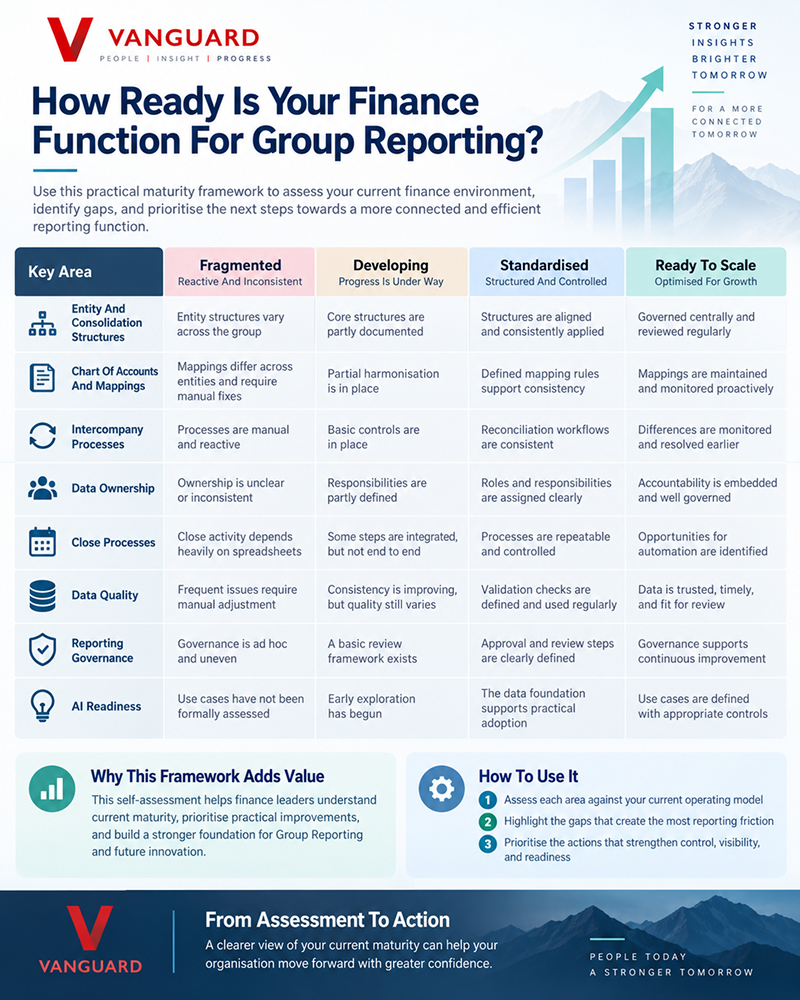
Aligning Implementation With Long-Term Business Goals
Your roadmap should prioritise measurable bottlenecks such as reporting speed, traceability or manual submissions, while ensuring that technology decisions support your broader finance transformation goals.
The Enterprise Development Grant provides current information on eligibility and support areas for Singapore businesses. Funding suitability should be checked against the latest criteria rather than assumed.
Supporting Long-Term SAP Transformation
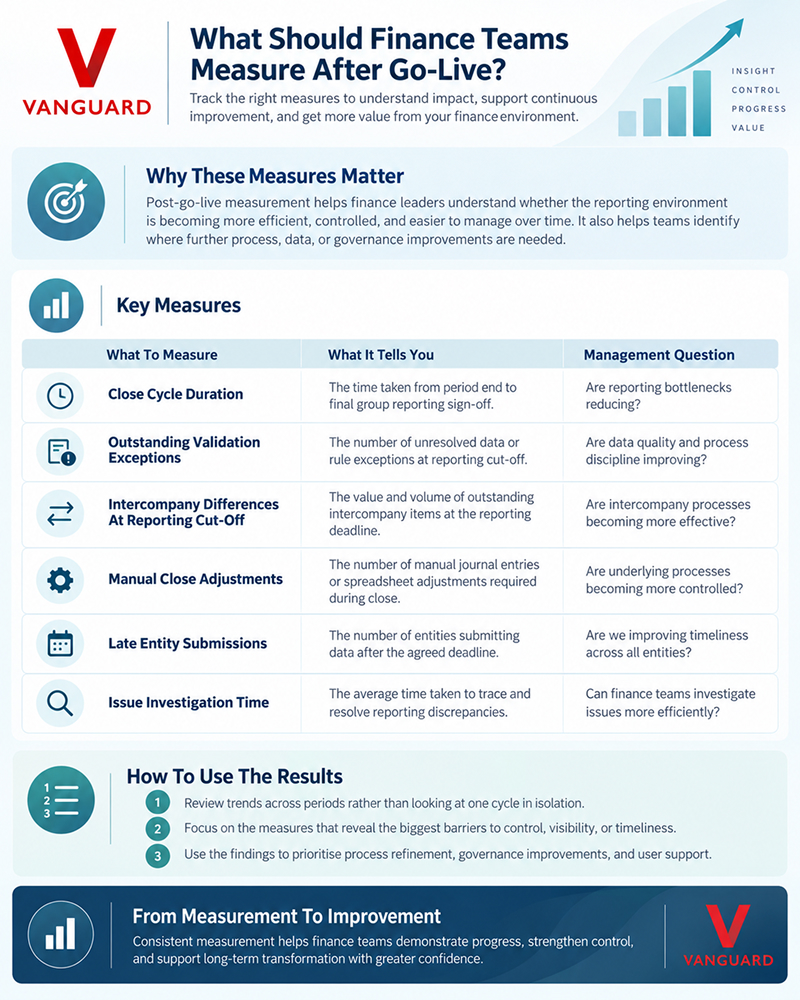
After go-live, entities and reporting structures will change. Maintain change governance, data ownership, regression testing, role maintenance and periodic control review so the platform stays aligned with finance.
Frequently Asked Questions
These questions usually arise when finance leaders move from product awareness to implementation planning.
1. Is SAP S/4HANA Finance for Group Reporting suitable for organisations with multiple subsidiaries?
Yes. For a multi-entity group, the question “What is SAP S/4HANA Finance?” becomes particularly relevant when local and group information needs to be brought into a more connected process.
It is particularly useful where subsidiaries operate with different currencies, source systems or reporting structures, provided the group data model and ownership rules are clearly defined.
2. What should businesses consider before implementing SAP S/4HANA Finance for Group Reporting?
A useful way to frame SAP S/4HANA Finance before implementation is to assess your current-state close. Document entities, ownership, charts of accounts, source systems, mappings, intercompany flows, manual journals, approval roles and reporting outputs.
You should also identify failure points such as late submissions, duplicate adjustments, poor master-data ownership and excessive spreadsheet dependencies.
3. Can SAP S/4HANA Finance for Group Reporting support future finance needs?
Yes. From a longer-term perspective, the question is whether SAP S/4HANA Finance can continue supporting integrated reporting, process automation and selected AI capabilities as business requirements evolve.
The sequence matters. Build the data model and controls, stabilise the close, then automate where it solves a measurable problem.
The investment should also be able to evolve with changes in entities, reporting structures and operating requirements. That makes governance, data quality, user adoption and ongoing design review important parts of the roadmap, rather than considerations that end at go-live.
Conclusion
When you are deciding on SAP S/4HANA Finance for your organisation, the next step should be a design workshop rather than another product demo. Map your entities, source systems, close bottlenecks, reconciliation pain points, reporting outputs and AI-readiness gaps. That will show where the platform can remove friction and where process change is still required.
If this is now part of your wider ERP roadmap, we can help turn your finance priorities into a practical implementation plan. Our focus is to connect finance requirements, data design, controls and user adoption so your SAP S/4HANA Cloud environment supports the way your group actually reports, reviews and grows.
Speak with Vanguard to assess your current finance environment and develop an SAP roadmap grounded in your reporting structure, control requirements and day-to-day close processes. We bring finance requirements and SAP system design into the same implementation conversation, helping your team translate entity structures, close controls, reporting needs, data requirements and user roles into a practical roadmap for ongoing improvement.